
Reolink Argus 4 Pro vs. Argus 4: Worth The Upgrade?
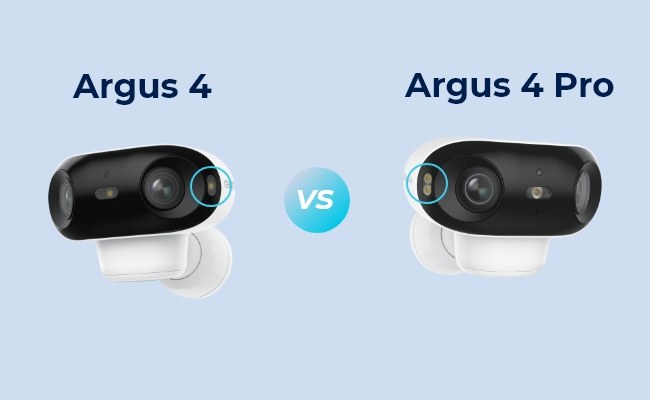
The Argus 4 line of cameras are some of the most gamechanging security cameras developed by Reolink. Both the Argus 4 and Argus 4 Pro share the same 4K resolution, the same 180° dual-lens field of view, and the same Wi-Fi 6 radio. But what separates them is how each one handles full darkness and how long each one runs on a charge.
This guide is for anyone choosing between the two models, whether you're upgrading from an older Argus or buying your first wire-free camera.
TLDR: The Argus 4 Pro provides spotlight-free color night vision and longer standby time with additional cost. To find out whether the cost justifies an upgrade for your situation, read on.
- Argus 4 Pro vs Argus 4: Comparison Table
- What Is the Reolink Argus 4
- What Is the Reolink Argus 4 Pro?
- Argus 4 Pro vs Argus 4: Differences and Similarities You Need to Know
- Argus 4 Pro vs Argus 4: Which One Should You Choose?
- Strengths and Limitations: Argus 4 Pro vs Argus 4
- How to Set Up the Argus 4 and Argus 4 Pro
- Is the Argus 4 Pro Worth the Extra Cost?
- FAQs
- Conclusion
Argus 4 Pro vs Argus 4: Comparison Table
What Is the Reolink Argus 4

The Reolink Argus 4 is a wire-free 4K security camera built around twin 2.8mm lenses that stitch into a single 180° panoramic view. It runs on a 5000mAh rechargeable battery, pairs with the optional Reolink Solar Panel 2 for continuous power, and stores footage locally on a microSD card or a Reolink Home Hu. No monthly fee required.
Key Specification Highlights
- Resolution: 4K UHD, 5120x1440 (8MP)
- Field of view: 180° horizontal, 50° vertical
- Night vision: true infrared (up to 30m) plus a spotlight-assisted color mode
- Connectivity: Wi-Fi 6, dual-band 2.4/5GHz, Bluetooth 5.0
What Is the Reolink Argus 4 Pro?

The Reolink Argus 4 Pro is the step-up model in the same wire-free lineup. It has a larger 1/1.8" sensor and F/1.0 lens for ColorX full-color night vision, which also draws less power than infrared and stretches standby time by roughly 30% over the Argus 4. It still matches the Argus 4 on the essentials such as 4K resolution, 180° field of view, and Wi-Fi 6 connectivity.
Did You Know? The Argus 4 Pro's ColorX night vision has earned recognition well beyond user reviews. MakeUseOf scored it 9/10 and gave it a "Recommended 2024" badge, and TIME magazine named it a Special Mention in its Best Inventions of 2024 list, citing it as the world's first 4K full-color night vision battery security camera.
Key Specification Highlights
- Resolution: 4K UHD, 5120x1440 (8MP)
- Field of view: 180° horizontal, 50° vertical
- Night vision: ColorX full-color (default), with built-in spotlights as backup for near-total darkness
- Battery: 5000mAh, same cell as the Argus 4, extended standby via efficiency
Argus 4 Pro vs Argus 4: Differences and Similarities You Need to Know
Which Security Camera Has Better Night Vision?
The Argus 4 Pro and Argus 4 solve darkness in fundamentally different ways. The Pro leans on ColorX, an F/1.0 lens paired with a 1/1.8" sensor that pulls in 4x more ambient light than a standard sensor, to deliver full-color video by default with no infrared LEDs at all. The Argus 4 Pro also has built-in spotlights (5 x 2W, 6500K) as a backup for near-total darkness, so it isn't spotlight-free in every scenario.

Reviewer's Take: The Ambient's hands-on test demonstrated that even with the spotlight off in near-total darkness around midnight, ColorX still produced "pretty vivid" colors and made the scene look noticeably lighter than it actually was.
One of the main reasons many would prefer to have color night vision is to be able to provide more detailed evidence, should the need arrives. A colored footage of a subject is always higher quality evidence as compared to a black and white one.
The Argus 4 takes the opposite approach. It has true infrared up to 30 meters, with a spotlight-assisted color mode for when full-color footage is needed. It does not have the Reolink ColorX sensor, so color night mode always requires the spotlight. It will fall back to genuine black-and-white IR (30m range) once the spotlight is off.
Pro Tip: If your install spot has zero ambient light, like an interior garage corner facing a blank wall, the Argus 4's true IR mode may perform more consistently than ColorX, which still benefits from some available light.
Which Security Camera Has Longer Battery Life?
Both cameras use the identical 5000mAh battery. The Argus 4 Pro's ~30% longer standby time comes from ColorX drawing about 2W/h less power than infrared LEDs, not from a bigger cell, according to Reolink's ColorX findings.
Cold weather affects both models the same way. According to Battery University's published research, lithium-ion batteries can lose a meaningful share of their rated capacity as temperatures drop, with losses of roughly 20-30% around freezing and more in deeper cold. The capacity returns once the battery warms back up, and the Solar Panel 2 accessory offsets most of the difference in practice by topping off charge daily regardless of ambient temperature.
Which Security Camera Has Better Resolution and Field of View?
Argus 4 Pro timelapse recording in 4K.
Both models offer 4K UHD at 5120x1440 (8 megapixels), 180° horizontal by 50° vertical, via twin dual-stitched lenses. Neither camera has an advantage here, so resolution isn't a reason to pick one over the other.
Which Security Camera Connects Better?
Both the Argus 4 Pro and Argus 4 provide dual-band Wi-Fi 6 (2.4GHz and 5GHz) and Bluetooth 5.0 for initial setup on both models. Neither has a connectivity edge.
Which Security Camera is Easier to Install?
Both cameras use the same 3-step wireless setup. They connect over Wi-Fi, pair via Bluetooth for configuration, then optionally attach the Solar Panel 2. Digitalreviews.net's hands-on review of the Argus 4 Pro reports the full process, unboxing to live stream, took under five minutes.
Which Security Camera Costs Less to Own?
First off, neither model charges a mandatory subscription. Both store footage locally on a microSD card (up to 512GB) or a Reolink Home Hub, with Reolink Cloud available as an optional paid add-on rather than a requirement.
The Argus 4 Pro typically carries a $20 to $50 premium over the standard Argus 4 in the camera-plus-solar-panel bundle, depending on current promotions, and that premium buys you spotlight-free ColorX night vision and roughly 30% longer standby time. If neither matters for your install spot, the standard Argus 4 delivers the same resolution, field of view, and connectivity for less.
Argus 4 Pro vs Argus 4: Which One Should You Choose?
The right choice depends on your setup and what "night vision" needs to mean for your specific install spot, whether you're buying your first Argus camera or already own a Reolink camera and are deciding what to add next.
Strengths and Limitations: Argus 4 Pro vs Argus 4
Argus 4 Pro
Strengths
- Full-color night vision without a visible spotlight, via ColorX (its built-in spotlights only kick in as backup for near-total darkness)
- Larger sensor and wider aperture (1/1.8", F/1.0) for low-light detail
- ~30% longer standby time from the same battery
Limitations
- No true infrared mode; relies on ColorX and backup spotlights only
- No native RTSP or ONVIF on the camera by itself; RTSP streaming and NAS storage only become available when paired with a Reolink Home Hub
Argus 4
Strengths
- True infrared night vision (up to 30m) for genuinely dark install spots
- Lower entry price
- Same 4K resolution, 180° FOV, and Wi-Fi 6 as the Pro
Limitations
- Color night mode requires the spotlight to be active, no spotlight-free color option
- Smaller sensor and narrower aperture (1/2.7", F/1.6) than the Pro
How to Set Up the Argus 4 and Argus 4 Pro
Setup is identical for both models and it's a breeze to set them up:
- Charge the camera fully before first use.
- Download the Reolink App and scan the camera's QR code.
- Connect the camera to your Wi-Fi network (2.4GHz or 5GHz).
- Complete Bluetooth-based pairing (BLE-config) for a faster initial connection.
- Mount the camera and, if using solar power, attach the Solar Panel 2 within its 4-meter cable range.
- Set motion zones and notification preferences in the app.
Reviewer's Take: Digitalreviews.net's hands-on test of the Argus 4 Pro completed this entire process, unboxing to live stream, in under five minutes.
Is the Argus 4 Pro Worth the Extra Cost?

This is the question most buyers on this page are actually asking, whether you're comparing the two for a first purchase or already own a Reolink camera and are weighing an upgrade.
Our answer, in short: it comes down to how much ambient light your installation spot gets, since that determines whether the Argus 4 Pro's spotlight-free ColorX video earns its premium over the standard model's infrared mode. One clarification worth making upfront is both cameras run the identical 5000mAh cell, so the Argus 4 Pro's edge comes from ColorX drawing less power than infrared LEDs, not from a bigger battery.
Pricing moves with promotions. So, treat any specific dollar figure as a snapshot rather than a fixed number, but the Pro consistently costs more than the Argus 4 as it is inherently a higher-specced model. If your camera faces a spot with some ambient light, ColorX's spotlight-free color video is a genuine upgrade worth paying for. If your camera faces true darkness with no ambient light source at all, the standard Argus 4's infrared mode may serve you just as well for less money. If you already own an older Argus model, the Pro's sensor and efficiency gains are the more noticeable upgrade of the two.
FAQs
1. What is the range of the Reolink Argus 4 Pro's PIR sensor?
The PIR detecting distance of the Argus 4 Pro is adjustable up to 10 meters (33 feet).
2. How long does the Reolink Argus 4 Pro's battery last?
The Argus 4 Pro's battery life varies with settings, usage, and temperature. A rough estimate is around 2 months per charge at roughly 300 seconds of recording per day and you'll get a low-battery notification at 10%. If a continuous charge is required, Reolink's Solar Panel 2 can facilitate that.
3. What is the actual resolution of the Argus 4 Pro's panorama, in megapixels?
8 megapixels (5120x1440), stitched from twin 4mm lenses into a 4K UHD, 180° panorama.
4. Does the Reolink Argus 4 Pro have infrared night vision?
No. The Argus 4 Pro has no infrared LEDs; it uses ColorX full-color night vision by default, with built-in spotlights as a backup in near-total darkness. The standard Argus 4 has true infrared (up to 30m) in addition to a spotlight-assisted color mode.
Conclusion
Before you decide, spend a few evenings watching your actual installation spot after dark. Any ambient light at all, a porch lamp, a neighbor's motion light, even distant street glow, points toward the Pro's ColorX advantage. Genuine darkness with no light source nearby points toward the standard Argus 4's infrared fallback instead. That one observation determines which camera performs better at your address.
Clearer on what's better for you? Check the Argus 4 Pro's live pricing or the Argus 4's current listing once you've made the call.
Search
Subscribe for the Latest Updates
Security insights & offers right into your inbox